
It is hoped that Hete-2 will enable scientists to catch a burst while it is still going on.
| ★ wanayoo — archive 1999 http://news.bbc.co.uk/low/english/sci/tech/newsid_963000/963658.stm | Nouvelle recherche | Portail wanayoo |
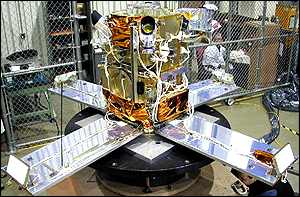
A satellite designed to detect mysterious bursts of gamma rays from the far reaches of the Universe was launched into orbit on Monday.
The High Energy Transient Explorer-2 (Hete-2) went into space on a Pegasus booster, after being released from the underside of an aircraft wing.
The rocket separated from the L 1011 "Stargazer" plane at 11,890 metres (39,000 ft). Within minutes, Hete-2 was delivered into an orbit ranging from 637 to 650 kilometres (396 to 406) and inclined 1.9 degrees to the equator.
Its four-year mission is to investigate the most powerful explosions in the Universe since the Big Bang. The satellite can locate the high-energy bursts of radiation, and e-mail alerts to astronomers.
It is hoped that Hete-2 will enable scientists to catch a burst while it is still going on.
A possible explanation for the mysterious events which last from milliseconds to a few minutes is the collision of two black holes or a particular type of star explosion called a hypernova.
Hete-2, which cost $8.4 million, carries three instruments to detect the bursts, and is a replacement for the original Hete that was lost in a launch failure of a Pegasus rocket almost four years ago.
Monday's release was from an aircraft that had taken off from the Kwajalien Missile Range on the Marshall Islands in the Pacific. It was the first time that a satellite had been put up from the site known for testing ballistic missiles.
It was also the 30th flight for the Pegasus rocket in its 10-year programme.