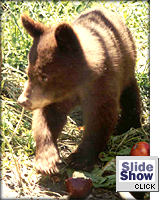
Sally did something the experts said she couldn’t do. She became the “mother” to orphaned bears without making them so dependent and so fearless of humans that they would become nuisance bears and have to be killed.
“She’s had a great success rate,” says Susan Sherwin of the World Society for the Protection of Animals, a grass-roots international organization that has begun underwriting some of the costs of maintaining Sally’s Idaho Black Bear Rehab Center on the outskirts of Boise.
Sally was already a veteran animal rehabilitator in 1989 when an official with the Idaho Department of Fish and Game asked her to see what she could do with an orphaned black bear. She had been rehabilitating animals for years, starting with a squirrel she found in her front yard after it had been hit by a car. She soon moved up to fox and coyotes and bobcats and even cougars, but the bear was something else.
A Pioneer in Her Field
“It just hooked me good and reeled me in,” she says. “It’s been nothing but bears since then.”
In the beginning, she had no idea how to raise a bear without “imprinting,” or making the bear identify more with her than other bears. So she set out to learn about other programs.
“I couldn’t find any,” she says. “I went through a whole list of 1,500 animal rehabilitators and never found anyone who had worked with a bear.” There were bear trainers, and bear researchers, but no experts who raised bears with the sole intent of returning them to the wilds, she says.
It turns out that state agencies across the country refused to license rehabilitators to work with bears out of fear of producing a bunch of problem bears. Better to put the cubs in a zoo, or let them die, than add to a public safety problem that leads to the destruction of scores of bears each year that have lost their fear of humans.
Sally figured there had to be a better way, and with the help of John Beecham, a black bear expert with the Idaho Department of Fish and Game who had enjoyed some success rehabilitating bears, she vowed to find it.
It took about five years, spending three or four hours a day with orphaned bears that kept turning up at her two-acre facility, to learn “what it’s like to be a bear cub,” she says.
And she learned something else. If these cubs were going to survive, she would have to become their “mother.”
Cubs: Hyper and Rough
During the few months the cubs are in her care, they “go through various stages of development, just like kids do,” she says. When they are very young, they are “wired and hyperactive,” slapping her around as she tries to feed them, just like they would their natural mother.
She’s the only one who feeds them, and “they bond with me and only me,” she says. And contrary to what had been thought, that bonding is ok.
Playtime can get a little rough when the cubs decide “let’s take mom down and chew on her for awhile,” she says, but she has never been hurt so much that she required medical attention.
Within a few months the bears begin to change and “mellow out,” she says. And like a lot of teenagers, they grow a little less fond of parental attention. They can get downright nasty if “mom” tries to make them do something they don’t want to do, and she occasionally has to take steps to avoid bears that seem particularly agitated.
But around October, something quite amazing starts to happen.
“Their wild instinct seems to mature and start kicking in,” she says.
They seem to know that even if Sally fed them, she isn’t one of them.
Breaking the Bond
By December the bears are ready to hibernate, and they no longer want anything to do with mom. So officials with the state Department of Fish and Game take them out to the wilds and put them in existing bear dens. At that stage the bears are afraid of just about everything, because they really don’t understand what’s dangerous and what’s helpful, so they become very wary of humans.
By the time Spring rolls around, the bears emerge as wild as their cousins who had a more traditional upbringing.
Of the bears that passed through Sally’s center, five died from disease or injuries, but 50 made it to maturity. Only one became a nuisance bear, and that was because some well-meaning but ignorant folk left food out for it. That bear was captured and ended up in an animal park, something Sally says she would never allow to happen again. She would rather see the bear destroyed than captured, because she no longer has any control over it and can’t guarantee that it is being treated well.
By now, you might think Sally wouldn’t care all that much about each bear. After all, if you’ve seen one bear, you’ve seen them all, right?
No way.
“Each bear has its own personality,” she says. “They are all unique.
“We had one bear named Griz [because it looked like a grizzly even though it was a black bear] who was just a real handful, a very powerful, determined bear. He just ran you through the gamut of emotions. He would make you mad, then he would frustrate you, then he would make you laugh until you were crying. He could just reach out and touch you and you would be in awe of the empathy this bear could express.
“It’s probably an insult to the bears to say this, but at times I’ve seen more humaneness from bears than I’ve seen from humans.”
Catching On
Her program has spread in recent years to other states, and now there are nearly a dozen bear rehabilitation programs patterned after hers.
Today, Sally’s haven for bears is surrounded by residential subdivisions, and she has to work to keep her bears isolated from interested neighbors. Only one neighbor is allowed in the enclosure to help her with the bears, and he remains distant enough so that the bears don’t bond with him.
They only do that with one person. Mom, after all, really does know best. 
Lee Dye’s column appears weekly on ABCNEWS.com. A former science writer for the Los Angeles Times, he now lives in Juneau, Alaska.


 HOME
HOME
 BUSINESS