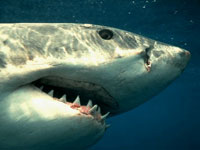
Great
white sharks are an enigma, as scientists are still
trying to unravel the mysterious lifestyle of these
denizens of the deep. They are solitary creatures
roaming the ocean in constant search of food. No one
knows how to tell the age of a great white shark or
how long they live, how often and where they breed,
how quickly they grow, and whether they lay eggs or
give birth to live young.
It is widely
held among shark experts that the great whites take a
long time to reach the fearsome proportions of record
and that over fishing of these incredible creatures
has led to a rapid decline in their numbers. No one
knows how long it would take for the world's great
white shark numbers to rebound if we were to
completely halt fishing of this species. We are now
beginning to realize the important role they play in
their ecosystem, eliminating the weak and the sick
from their environment and keeping seal and sea lion
numbers in check. Lack of great white sharks to
control the sea lion population may be one of the
contributing factors to the declining salmon
populations along the coast of California and Oregon.
What scientists
have been able to study in great whites is their
predatory and feeding behavior. In the Farallon
Islands, off the coast of California, scientists are
videotaping and documenting attacks on
pinnipeds (seals and sea lions - the sharks'
favorite prey) to understand how these awesome killing
machines operate. By studying shark attack behavior,
scientists hope to understand and predict how and when
a great white will attack. People who "use" the ocean
can use this information to protect themselves from
being attacked by a great white shark.
Expert
Killing Machines
Great white
sharks have a number of adaptations (behaviors and
anatomical features) that make them such efficient
killers:
For
sensing -
specialized sensory organs called
ampullae
of Lorenzini located
in the shark's snout, which can detect electrical
currents of as little as .005 millivolts that are
generated by every living creature in the
water
Extremely
accute and sensitive sense
of smell,
allowing the great white to detect the most
miniscule amounts of blood in the water up to 5km
away - blood means injured victim = less effort
required for the meal (Efficiency!)
For
stalking
- the coloring of the great white makes for
excellent camouflage in the ocean - dark above, and
light below makes it difficult to be detected while
swimming on the bottom (great whites strike from
below)
For
striking
- a large, powerful body and specially designed
tail that provides for enormous bursts of energy
for striking with such tremendous strength that the
first bite is a frequently a death blow
Several rows
of razor
sharp teeth
that are continually replaced to ensure an entire
jaw of efficient, lacerating implements
Scientists who
study the Great White Shark have found that when
attacking their prey, the strategy of the great white
is usually to strike from below in one powerful blow
(some human shark attack victims have likened the
experience to being hit by a car), inflicting a lethal
bite to head or trunk of its victim. The shark then
swims away a short distance to let its victim bleed to
death so that it will not have to struggle with its
meal. This brief respite after the initial chomping is
what allows many human victims (but not all) to escape
being eaten alive by the great white
predator.
The
largest great white on record measured 21 feet long
(some claim a 23 footer was caught in the
Mediterranean). Since great whites are such elusive
and mysterious creatures, it's entirely possible there
may be even bigger ones out there we have yet to meet.
Paleontologists
have found the fossilized jaws of an ancient ocean
predator that is an ancestor of the great white,
called Charcharodon
megalodon.
The size of the jaws indicate the size of the
creature may have been as large as 50 feet long! Some
scientists argue that it's possible these monsters
still exist in the ocean deeps, that we just haven't
found them yet.
There are other
large species of living sharks that have reputations
for ferocity that rival the great white. The bull
shark, white tip reef sharks, blue sharks, tiger
sharks, seven gill sharks, and some monsters of the
deep that are 20 feet or more - sleeper sharks and
primitive six gill sharks. These species of sharks may
rival the ferocity of the great white, but none of
them have been found to grow as large. But,
Carcharodon carcharias is not the largest ocean
predator - there are other, larger ocean
carnivores...
The King of
the Seas: Orca
Also known as
"Killer Whales", most of us are familiar with them as
the attractive and friendly creatures who smile at us
from the pool at Sea World or Marine World, even
giving "kisses" to their handlers. Considered the
largest member of the dolphin family, they possess the
second largest brain in the entire animal kingdom.
With large males reaching up to 32 feet in length and
weighing over 10 tons, Orcas are some of the largest
predatory carnivores to roam the seas!
They
are found in oceans the
world over,
being as widely distributed as the most familiar
species of creature - humans. We tend not to think of
Orcas as being predators of the ocean, but their diet
consists of pretty much the same thing as sharks; lots
of fish, seals, and sea lions. What many people don't
know about killer whales is that the Spanish used to
call them, "whale killers" because they have been seen
preying upon other whales, including the most immense
of all creatures - the Blue
Whale!
Although they
are enormous predators of the sea, no human has ever
been killed by an Orca. They possess a gentle
intelligence that permits them to discern other
creatures with much greater precision than the Great
White. The menu list imprinted in the Orca's brain
does not include people and they're very good at
making that distinction. In a clash between the Titans
of the deep, the Orca and the Great White, there is no
contest. Find out about just such an encounter that
was documented with video footage and see who
won!
Orca
vs. Great White Shark
The
Heavyweight Champion of the World:
The Mighty Sperm Whale
The winner of the title of the
Largest Ocean Carnivore goes to the sperm whale. The
largest of the toothed whale species in the world.
Adult males can grow up to 60 feet long and weigh 40
tons (read - 80,000 pounds!). Males are usually about
twice as large as the females. They have a pretty long
lifespan, about as long as people, living up to 70
years. Sperm whales have been found living in every
ocean in the world.
Just like you and me, the sperm
whale is born without teeth. They drink milk from
their mother's mammary glands, just like baby people
do. They finally grow teeth in their massive jaws when
reaching sexual maturity. Sperm whales have strong
conical
(cone-shaped) teeth on their lower jaw and only
remnants of teeth in the upper jaw. The largest teeth
are 11 inches long! That's about as long as an adult
human's forearm. Can you imagine? One tooth from the
mouth of this massive creature is as big as your arm.
Do you think he could eat you? It's not
likely you'll find yourself being eaten by a sperm
whale, they don't eat people. Their favorite food is
squid.
It takes a lot of food to keep a
big sperm whale happy - about a ton of food a day.
Scientists have measured them diving down as deep as
3,000 meters and holding their breath for two hours to
go after the squid that they love to eat so much. They
also feed on other creatures, such as octopus and
fish. But sperm whales have been the stuff of legends
because of their massive size and predatory nature and
because of the telltale markings left on their bodies
by the giant squid they stalk and hunt in the great
ocean depths. To date, the best evidence scientists
have of the existence of giant squid are the scars the
suckers from the squid's tentacles left on the whales'
skin, and the large pieces of partially digested giant
squid found inside the whales' stomach.
Read
more about giant squid
here at Extreme Science.
The great ocean carnivore has
been known to eat another great ocean carnivore - the
great white shark! So the sperm whale really is the
baddest of them all....